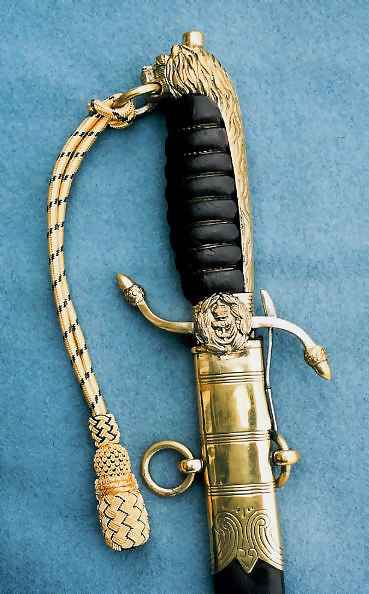
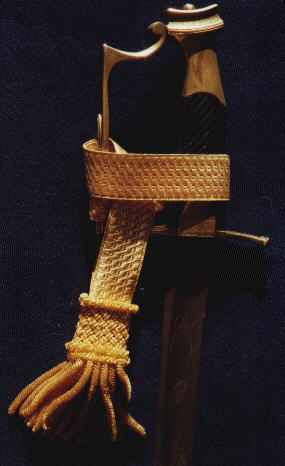
You are here: HOME> ARMS COLLECTION> SWORDS> Sword Knots          

Other Sections of Interest: British Swords French Swords  German Swords  Sword Knots   Muskets / Bayonets

The Discriminating General's


British Army  - Royal Air Force - Royal Navy - French Napoleonic  - United States

"No Sword can be properly regarded as complete without its appropriate knot"
- Sword historian B. Robson from his definitive work: Swords of the British Army

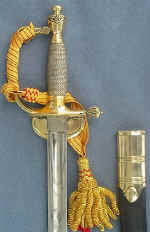
   Recently there has been a demand for good quality sword knots from collectors, museums, and quality reenactors.  By and large the sword knots available to reenactors resemble curtain tassels then historic sword knots.  Sword collectors know all-too-well how few original sword knots appear for sale. To answer this need, we have brought together the largest collection of sword knots anywhere.  After studying a number of originals knots in museums and collections throughout Britain, France and North America, the following knots are the result. 

All our sword knots are made from superior materials woven in France and are of spectacular quality backed with a money-back guarantee.


British Army


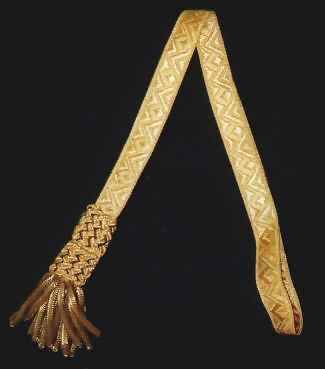
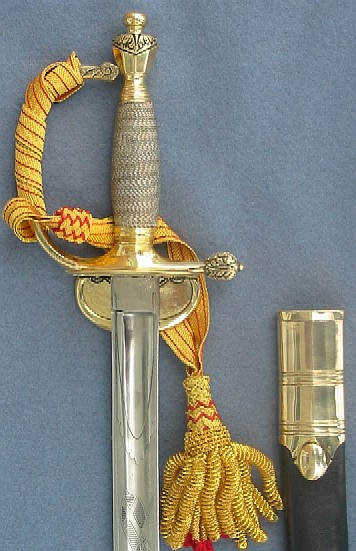
Infantry and Artillery Officer pattern 1747-1812  95.00US (99.00CAN) KNT008   This knot was probably the most famous of officer's knots. It was made with fringe or light bullion and was still used up to the War of 1812. However heavier bullions, like on the next knot, seemed to have been preferred by field officers as early as the American Revolution.

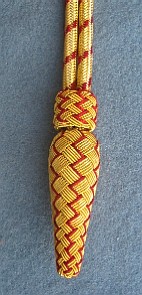
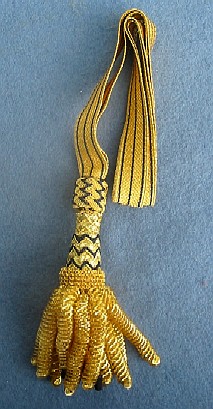
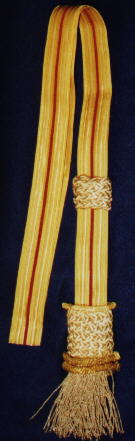
Infantry and Artillery Officer pattern 1790 -1857  45.50US (49.50CAN) KNT023   This knot is very similar to the above knot, except the bullions become larger and the top of the tassel becomes hour glass shape.  Evidence shows it being used as early as 1790 with some officers.  It may have been used earlier.   Surprising it was not officially recognized as a pattern until 1822 although it was dominant from about 1812.  The constants are the three crimson lines on its gold strap.  Was also used as the undress knot for the life guards and the horse guards (1796-1822).  In addition Royal Artillery officers also used this knot up to 1857.

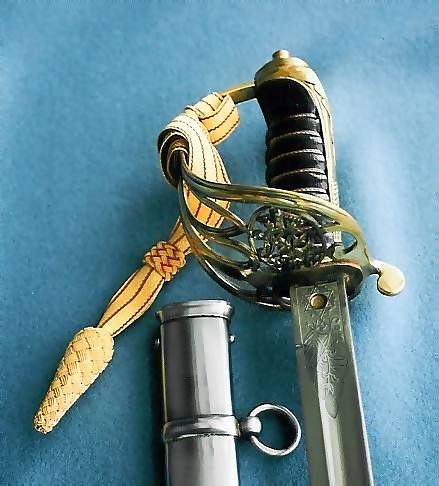
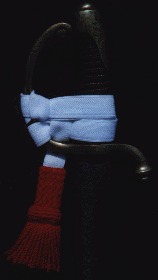
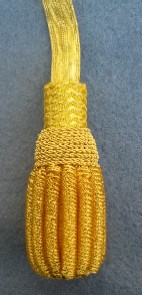
British Infantry Sword Knot 1857-1950 55.00US(57.50CAN) KNT022 In 1857 the bullion tassel gave way to the gold acorn.


knot2.jpg (7158 bytes)

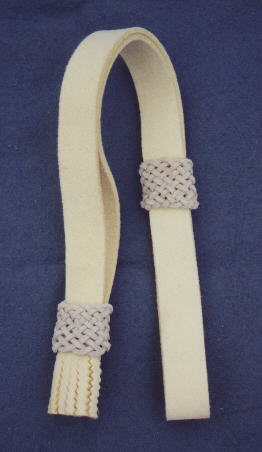
British Cavalry Buff Leather Sword Knot 1796-1822 75.00US (80.00CAN) KNT009 This is the trooper's knot.   The strap measures 1/2 inch in diameter, however there are original examples of 1 inch in diameter (French adaptation).  This knot evolved into one with a brass button adjustment after 1822.  Interestingly enough some infantry officers adopted this style (62nd Regiment for example) because of its more practical nature.  The 62nd had their coloured to a buff (yellow ocre pipe-clay mixture).  This can be done for an additional 10.50US (11.50CAN).


cordknt2.jpg (64001 bytes)

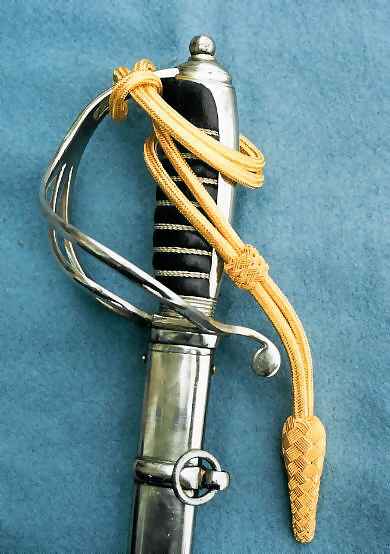
Gold Cord with Acorn Tassel Sword Knot  42.00US (45.00CAN) KNT010.  This pattern saw extensive use in the Light Dragoons 1831-1860 and in the Foot Guards from 1855 to 1945.  It is the perfect companion with the 1822 Light Cavalry Sword on our sword page; a sword made famous by the Charge of the Light Brigade.  In addition, it was used by the Royal Engineers from 1857 to 1945, including a certain engineer commanding Rorke's Drift in the Zulu conflict.  1822 Light Cavalry Sabre with Knot


gd_knot1.jpg (10495 bytes)

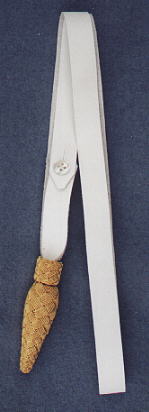
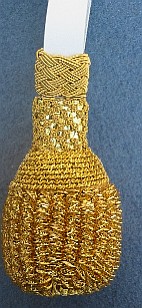
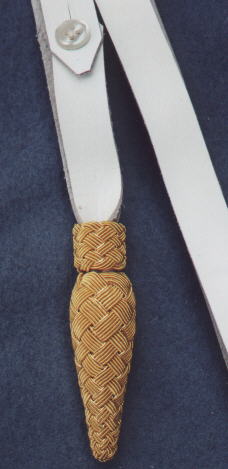
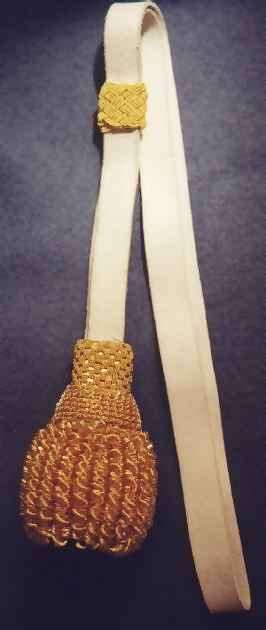
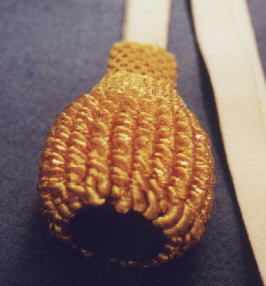
White Leather Knot with Gold Acorn 43.00US (49.00CAN)KNT011.  This knot was and still is the undress knot for the Foot Guards, beginning in 1883. It was also adopted by most of the Heavy Cavalry from 1883 on as did the Infantry as their undress knot from 1874 onward.  Detail Image


lancerknot.jpg (65769 bytes)

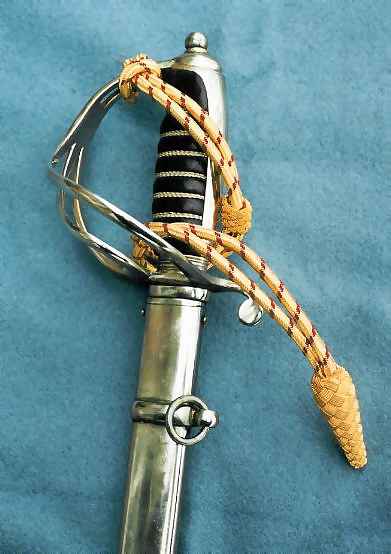
Crimson and Gold Cord and All Gold Acorn Knot 65.00US (69.50CAN) KNT014.  The first unit to use this combination was the Lancers (1822-1945). The Hussar regiments took this up from 1883 onwards. (A special order item.)  1822 Light Cavalry Sabre with Knot


knot6.jpg (24940 bytes)

Buff Leather and Gold Tassel with Crimson Centre 65.00US (69.50CAN) KNT013.  This knot was used by various cavalry units at various times.  The 1st Life Guards used on and off throughout it history (1796 -1822, 1831-1857, 1872-1945).  The Heavy Cavalry used it from 1822 to 1883.  T  Image of detail

knot8.jpg (20524 bytes)

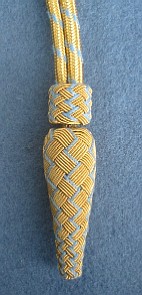
Crimson and Gold Cord and Acorn Knot 42.50US (45.00CAN) KNT012.  This knot is appropriate for General Officer's swords from 1831 to 1945, and Hussars, 1831-1883 (again the famous Charge of the Light Brigade). Image of detail


knot5.jpg (15636 bytes)

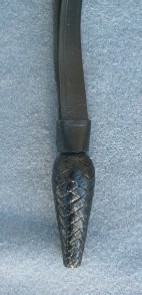
Rifle Regiment Black Leather Strap and Acorn. 35.00US (39.00CAN) KNT016  It has been debated that was used as early as the formation of the Rifle Corps.  Whether this is the case is uncertain.  Any rifle pattern sword into the 20th century had this knot it.

newknot1.jpg (19911 bytes)

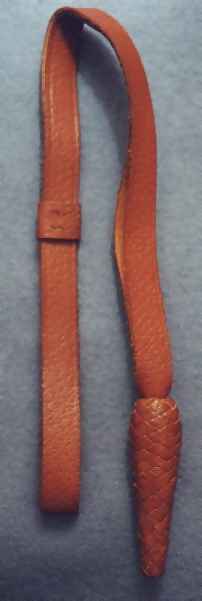
Universal Field Service Brown Leather Strap and Acorn. 35.00US (39.00CAN) KNT015.  Adopted in 1899, this knot saw extensive service in the trenches of WWI and is still used today.  This knot went especially with the field brown scabbard. Image of detail 
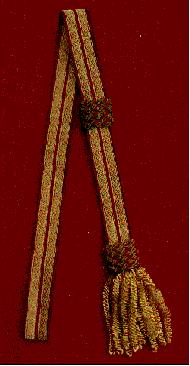


Royal Air Force


knot1.jpg (16805 bytes)

Royal Air Force Strap Knot 42.50US (45.00CAN) KNT024.   knot9.jpg (18385 bytes)  Air Force Cord Knot 42.50US (45.00CAN) KNT025.  


Royal Navy


rn_knot1804.jpg (40109 bytes)

Royal Navy officer pattern (Napoleonic)  65.00US (68.00CAN) KNT017  This sword knot was illustrated in a portrait of Rear Admiral Thomas Troubridge in 1805.

navy1800.jpg (43798 bytes)

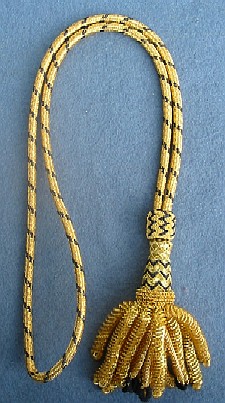
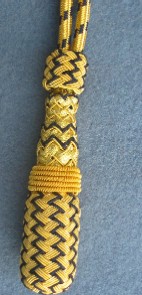
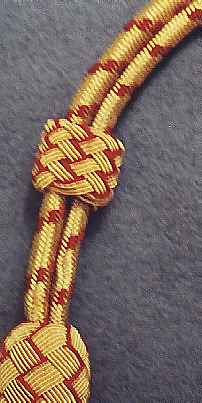
Royal Navy 1800-1890 Cord Knot (detail)   65.00.00US (68.00CAN) KNT018 used unofficially from 1800.  From 1827 on was used both with the second cord system (seen in KNT020) and without it.


navyknot.jpg (13687 bytes)

Royal Navy officer pattern  95.00US (99.00CAN) KNT029  There were numerous personal Royal Navy patterns being used prior to 1800.  cordknt3.jpg (8558 bytes) Royal Navy Cord Knot with Acorn Tassel  59.50US (65.00CAN) KNT019 out of stock


knot2.jpg (18054 bytes)

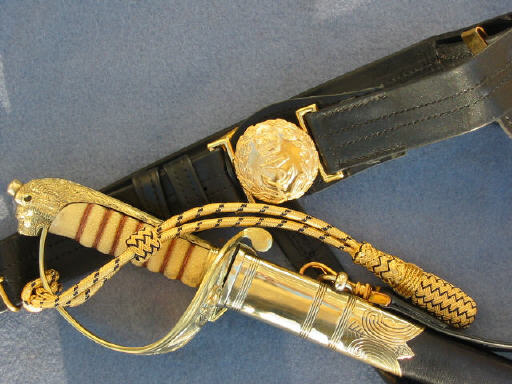
Royal Navy Double Cord Knot 44.50US (45.00CAN) KNT020  Used by both the Royal Navy and the Canadian Navy today.  In use since 1890.  See it on a sword.

dirkknot.jpg (52124 bytes)

Royal Navy Dirk Cord Knot  42.50US (45.00CAN) KNT021  Ideal for our RN dirk.  Image of Dirk with knot


French Napoleonic Sword Knots


guardknt.gif (15973 bytes)

Imperial Guard Other Ranks Sword Knot  95.00US (99.00CAN) KNT001

knot1.jpg (40956 bytes)

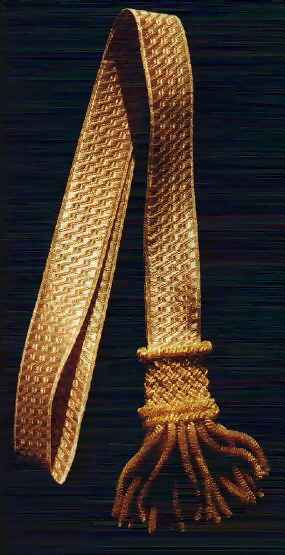
French officer Gold Sword Knot- Field Officer Grade or Captain's Grade  95.00US (99.00CAN) KNT002  Same Knot Showing Knotting Arrangement on Sword


cordknot.jpg (10331 bytes)

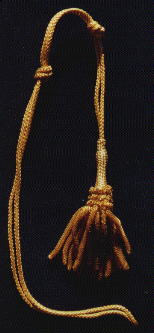
French Cavalry Officer Cord Style Sword Knot 95.00US (99.00CAN) KNT003

knot3.jpg (16394 bytes)

French Cavalry Trooper's Buff Leather Sword Knot 85.00US (95.00CAN) KNT004


knot5.jpg (13806 bytes)

French Lieutenant's Sword Knot with  Red Stripe and Fine Fringe  95.00US (99.00CAN) KNT005


 Sword Knots of the United States


  knot4.jpg (16504 bytes)
KNT026

knot7.jpg (19618 bytes)
KNT027

knot3.jpg (15435 bytes)
KNT028

 All U.S. Sword Knots:  35.00US (39.00CAN) each


visa.jpg (1236 bytes)
Click Here for FAX/Mail Order Form

Ordering Information


Militaryheritage.com Sites:

Seven Years War Website  Napoleonic Wars Collection  Military Heritage Magazine

Military Music Sound Clip Gallery     Home of the Discriminating General


Our Products and Services:

Our Mission and Clients   Product Index   Heritage Film Services    Seven Years War Replicas
American Rev Replicas      Napoleonic Wars Replicas    French Nap. Headdress 
British Army,1793-1815   British Army, 1816-1856    Military Buttons   Military Belt Plates
Swords     Sword Knots      Military Drums       Additional Products...


Contacting us


©
Copyright: Unless otherwise noted, all information, images, data contained within this website is protected by copyright under international law.  Any unauthorized use of material contained here is strictly forbidden.  All rights reserved.  The Discriminating General is in no way to be held accountable for the use of any content on this website.  See Conditions of Use.